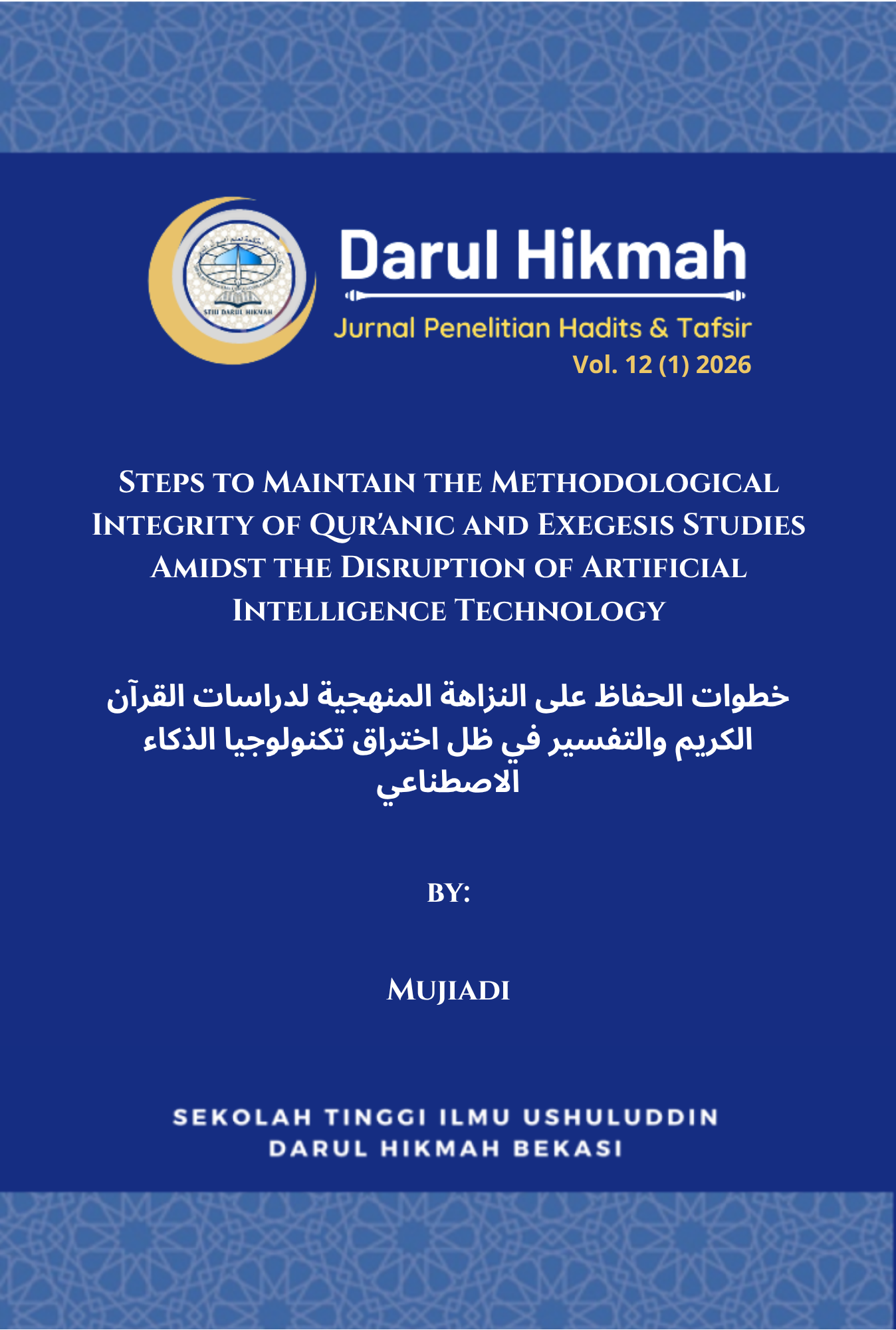
Steps to Maintain the Methodological Integrity of Qur'anic and Exegesis Studies Amidst the Disruption of Artificial Intelligence Technology
DOI:
https://doi.org/10.61086/jstiudh.v12i6.99Keywords:
Qur’anic Studies, Tafsir Methodology, Artificial IntelligenceAbstract
The disruption brought about by artificial intelligence (AI) technology has fundamentally transformed the ways in which knowledge is produced, disseminated, and consumed in contemporary academic contexts. This phenomenon has also extended into the field of Qur’anic and Tafsir studies, which has traditionally been grounded in rigorous methodological foundations, scholarly authority, and epistemological responsibility. This article aims to critically analyze the challenges and implications of the use of AI in Qur’anic and Tafsir studies by highlighting three main dimensions: epistemological, technical, and ethical. This study employs a qualitative approach based on a critical literature review of classical works in ʿUlūm al-Qur’ān, Qur’anic exegesis, as well as contemporary literature on AI ethics and epistemology. The findings indicate that although AI has significant potential as a research support tool, it lacks epistemic capacity to produce tafsir knowledge in a methodological sense. Therefore, systematic strategies are required, including the strengthening of methodological literacy, cross-disciplinary collaboration, and the establishment of strict regulatory and ethical frameworks to ensure that the use of AI does not blur the boundaries between information, knowledge, and scholarly authority in Qur’anic and Tafsir studies.
Downloads
Published
Issue
Section
License
Copyright (c) 2026 Darul Hikmah: Jurnal Penelitian Hadits dan Tafsir

This work is licensed under a Creative Commons Attribution-NonCommercial-ShareAlike 4.0 International License.
This work is licensed under a Creative Commons Attribution-NonCommercial-ShareAlike 4.0 International License.
You are free to:
- Share — copy and redistribute the material in any medium or format
- Adapt — remix, transform, and build upon the material
- The licensor cannot revoke these freedoms as long as you follow the license terms.
Under the following terms:
- Attribution — You must give appropriate credit, provide a link to the license, and indicate if changes were made. You may do so in any reasonable manner, but not in any way that suggests the licensor endorses you or your use.
- NonCommercial — You may not use the material for commercial purposes.
- ShareAlike — If you remix, transform, or build upon the material, you must distribute your contributions under the same license as the original.
- No additional restrictions — You may not apply legal terms or technological measures that legally restrict others from doing anything the license permits.
Notices:
You do not have to comply with the license for elements of the material in the public domain or where your use is permitted by an applicable exception or limitation.
No warranties are given. The license may not give you all of the permissions necessary for your intended use. For example, other rights such as publicity, privacy, or moral rights may limit how you use the material.