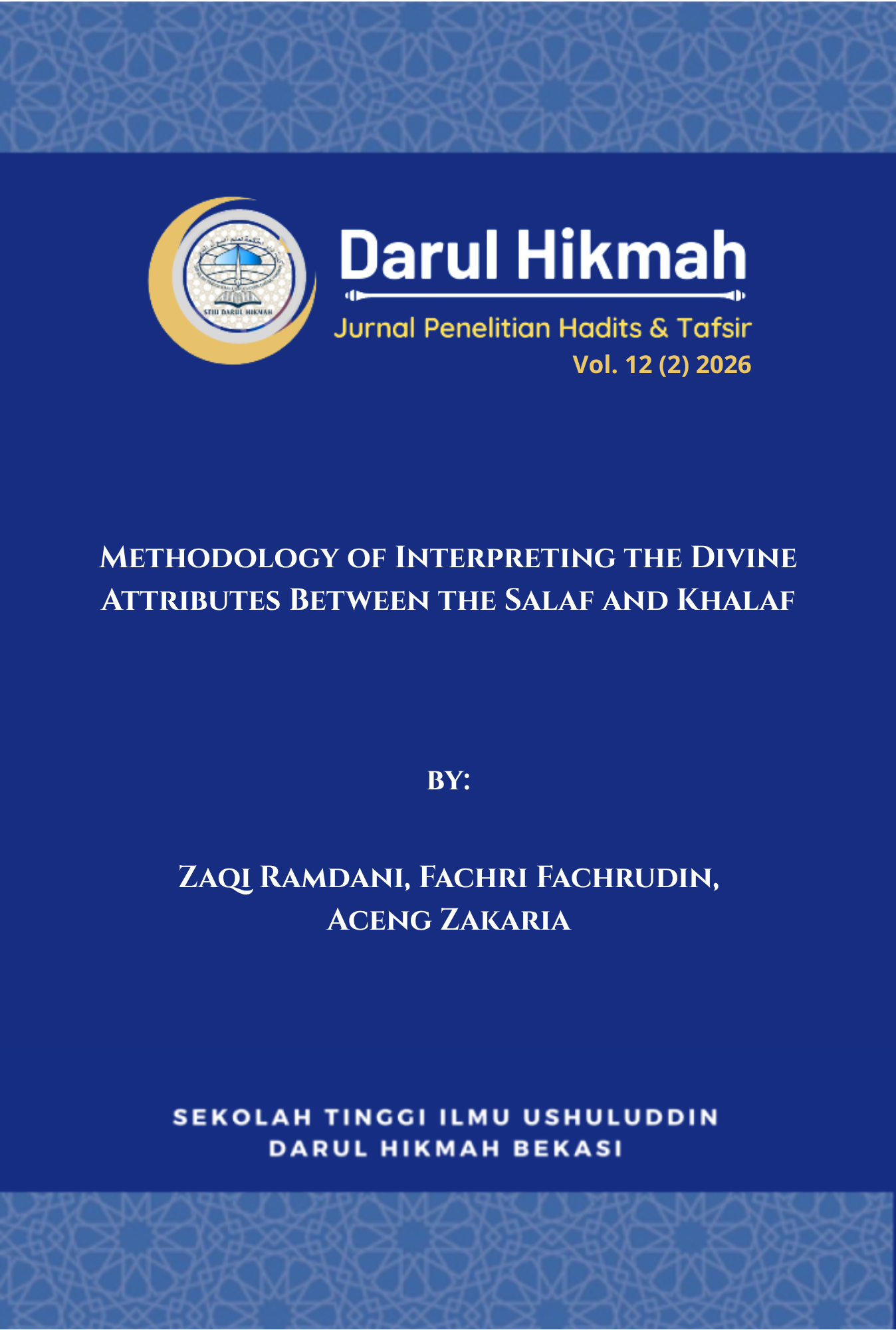
Methodology of Interpreting the Divine Attributes Between the Salaf and Khalaf
DOI:
https://doi.org/10.61086/jstiudh.v12i2.104Keywords:
Divine attributes, Salaf, KhalafAbstract
Debates surrounding divine attributes (sifāt dzātīyah) in Islamic thought often trigger sectarian polemics due to a literal reading of revelation. This study examines the tafsir methodology used to interpret Allah's dzātīyah attributes between Salaf and Khalaf, framing both not as chronological periods but as methodological orientations. Using a qualitative library research approach with a comparative analysis (muqāran) of classical tafsir and theological works, the discussion focuses specifically on three Qur'anic expressions: istiwā’, yad, and wajh. The findings demonstrate that the Salaf methodology affirms the textual wording of revelation (itsbāt), strictly rejects modal re-engineering (takyīf), physical resemblance (tasybīh), anthropomorphic modeling (tamtsīl), and textual negation (ta'thīl), while entrusting the ultimate modality (kaifīyah) entirely to Allah. Conversely, the Khalaf methodology employs disciplined linguistic interpretation (ta’wīl) driven by contextual semantical analysis whenever literal readings risk implying physical corporealism (tajsīm). The primary contribution of this research lies in systematically mapping the internal epistemological logic of both traditions in balancing absolute commitment to divine revelation with the foundational principle of divine transcendence (tanzīh). Furthermore, this study explicitly demonstrates that both traditions share an identical theological objective through distinct interpretative mechanisms, establishing a rational baseline for contemporary Qur'anic hermeneutics.
Downloads
Published
Issue
Section
License
Copyright (c) 2026 Jurnal STIU Darul Hikmah

This work is licensed under a Creative Commons Attribution-NonCommercial-ShareAlike 4.0 International License.
This work is licensed under a Creative Commons Attribution-NonCommercial-ShareAlike 4.0 International License.
You are free to:
- Share — copy and redistribute the material in any medium or format
- Adapt — remix, transform, and build upon the material
- The licensor cannot revoke these freedoms as long as you follow the license terms.
Under the following terms:
- Attribution — You must give appropriate credit, provide a link to the license, and indicate if changes were made. You may do so in any reasonable manner, but not in any way that suggests the licensor endorses you or your use.
- NonCommercial — You may not use the material for commercial purposes.
- ShareAlike — If you remix, transform, or build upon the material, you must distribute your contributions under the same license as the original.
- No additional restrictions — You may not apply legal terms or technological measures that legally restrict others from doing anything the license permits.
Notices:
You do not have to comply with the license for elements of the material in the public domain or where your use is permitted by an applicable exception or limitation.
No warranties are given. The license may not give you all of the permissions necessary for your intended use. For example, other rights such as publicity, privacy, or moral rights may limit how you use the material.