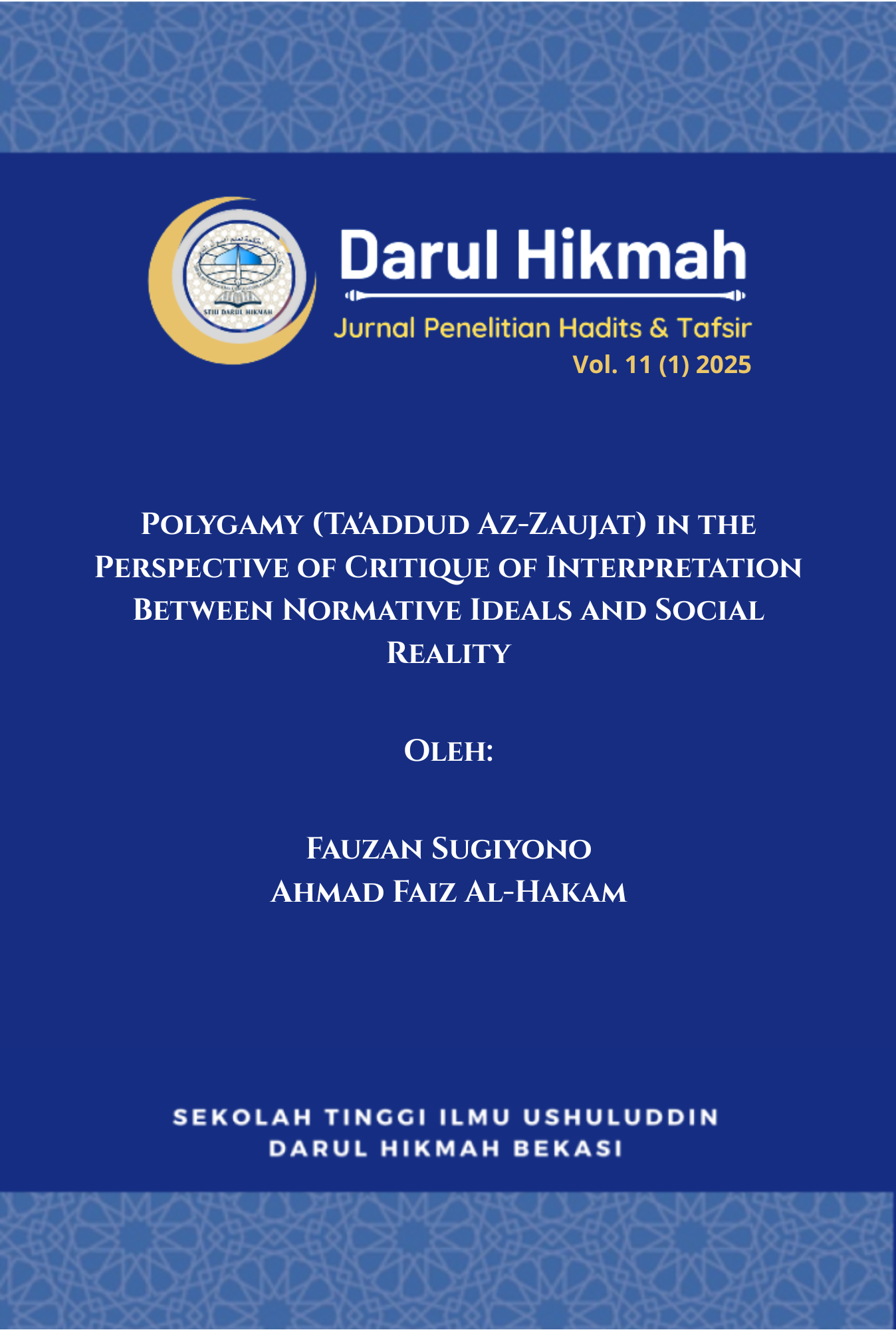
Polygamy (Ta'addud Az-Zaujat) in the Perspective of Critique of Interpretation Between Normative Ideals and Social Reality
DOI:
https://doi.org/10.61086/jstiudh.v11i1.63Kata Kunci:
Polygamy, Criticism of Interpretation, Classical Interpretation, Contemporary Interpretation, JusticeAbstrak
Polygamy (taʿaddud az-zaujāt) is a controversial issue in Muslim society, both from a social perspective and within Islamic law. Although this practice has a basis in the Qur'an, particularly Surah An-Nisa': 3 and Surah An-Nisa': 129, its interpretation continues to spark debate between classical exegetes and contemporary thinkers. The dominant critique of this verse tends to be literal and legal-formal, legitimizing polygamy as a form of absolute permissibility, without delving deeper into the meaning of the Qur'an's requirements for justice. As a result, the practice of polygamy in society often leads to gender injustice, unequal marital relations, and psychological and social burdens for women and children. The purpose of this study is to analyze the rationale of classical and modern exegetes regarding the differing legal views on polygamy and to evaluate the construction of classical normative thought to make it more holistic, empathetic, and in line with contemporary realities and the values of the maqasid sharia (the principles of Islamic law) in marriage. This study is a library research study using a descriptive analytical comparative method between classical and contemporary interpretations through a qualitative and social contextual approach. The results of this study indicate three differing views of commentators regarding the law of polygamy, each with its arguments: one group holds that polygamy is an absolute recommendation; the other holds that the recommendation is a conditional emergency; and the third rejects polygamy and even discourages it due to its numerous harms. Monogamy is a fundamental principle of marriage (munakahat) in Islam.
Unduhan
Diterbitkan
Terbitan
Bagian
Lisensi
This work is licensed under a Creative Commons Attribution-NonCommercial-ShareAlike 4.0 International License.
You are free to:
- Share — copy and redistribute the material in any medium or format
- Adapt — remix, transform, and build upon the material
- The licensor cannot revoke these freedoms as long as you follow the license terms.
Under the following terms:
- Attribution — You must give appropriate credit, provide a link to the license, and indicate if changes were made. You may do so in any reasonable manner, but not in any way that suggests the licensor endorses you or your use.
- NonCommercial — You may not use the material for commercial purposes.
- ShareAlike — If you remix, transform, or build upon the material, you must distribute your contributions under the same license as the original.
- No additional restrictions — You may not apply legal terms or technological measures that legally restrict others from doing anything the license permits.
Notices:
You do not have to comply with the license for elements of the material in the public domain or where your use is permitted by an applicable exception or limitation.
No warranties are given. The license may not give you all of the permissions necessary for your intended use. For example, other rights such as publicity, privacy, or moral rights may limit how you use the material.