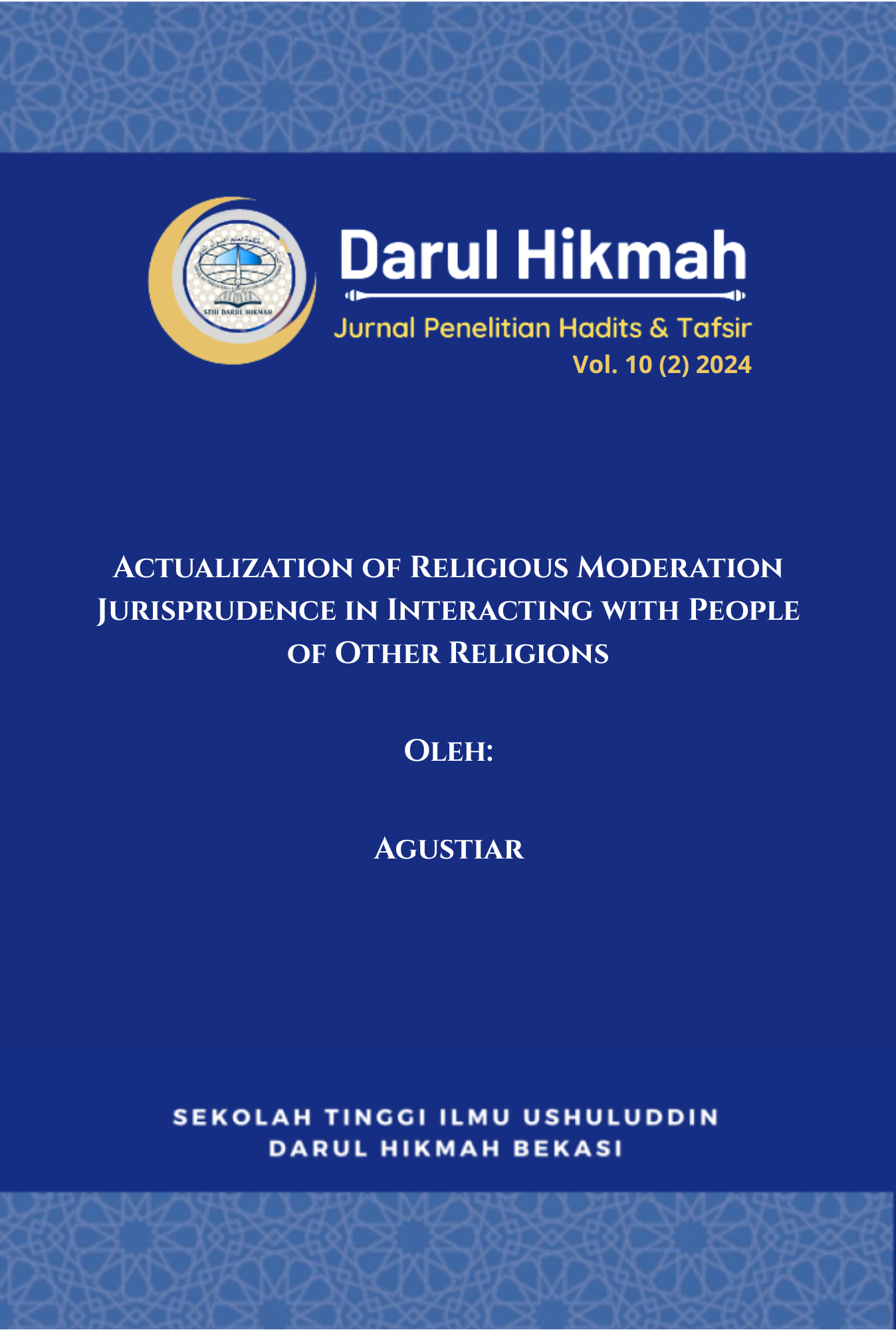
Actualization of Religious Moderation Jurisprudence in Interacting with People of Other Religions
DOI:
https://doi.org/10.61086/jstiudh.v10i2.66Keywords:
Actualization, Religious Moderation, Jurisprudence, Al-Qur'an PerspectiveAbstract
This article outlines the conceptual implementation of the jurisprudence of moderation in the context of inter-religious interaction, with an emphasis on the foundation of the Quran. Through the analysis of Quranic verses that emphasize the values of tolerance, dialogue, and justice, this article highlights the importance of moderation as the primary principle in fostering harmonious relations between religious communities. The purpose of this research is to examine the concept of religious moderation in interactions with people of other religions from the perspective of the Quran. This research has implications for promoting better understanding between religious communities, building harmony, and preventing conflicts caused by religious incomprehension. This research is a library research that combines qualitative analysis of literature and text sources with an in-depth theoretical approach. In this context, the researcher will collect and analyze various relevant literature sources, such as books, journal articles, conference papers, and other academic documents related to this discussion. The findings of this research state: 1) The Qur'an consistently encourages Muslims to practice positive actions and reject negative behaviors. 2) Dialogue and good communication have a very important role in building positive relationships between religious communities. 3) The Qur'an explicitly rejects violence in the context of religion and invites its people to spread the message of peace.
Downloads
Published
Issue
Section
License
This work is licensed under a Creative Commons Attribution-NonCommercial-ShareAlike 4.0 International License.
You are free to:
- Share — copy and redistribute the material in any medium or format
- Adapt — remix, transform, and build upon the material
- The licensor cannot revoke these freedoms as long as you follow the license terms.
Under the following terms:
- Attribution — You must give appropriate credit, provide a link to the license, and indicate if changes were made. You may do so in any reasonable manner, but not in any way that suggests the licensor endorses you or your use.
- NonCommercial — You may not use the material for commercial purposes.
- ShareAlike — If you remix, transform, or build upon the material, you must distribute your contributions under the same license as the original.
- No additional restrictions — You may not apply legal terms or technological measures that legally restrict others from doing anything the license permits.
Notices:
You do not have to comply with the license for elements of the material in the public domain or where your use is permitted by an applicable exception or limitation.
No warranties are given. The license may not give you all of the permissions necessary for your intended use. For example, other rights such as publicity, privacy, or moral rights may limit how you use the material.