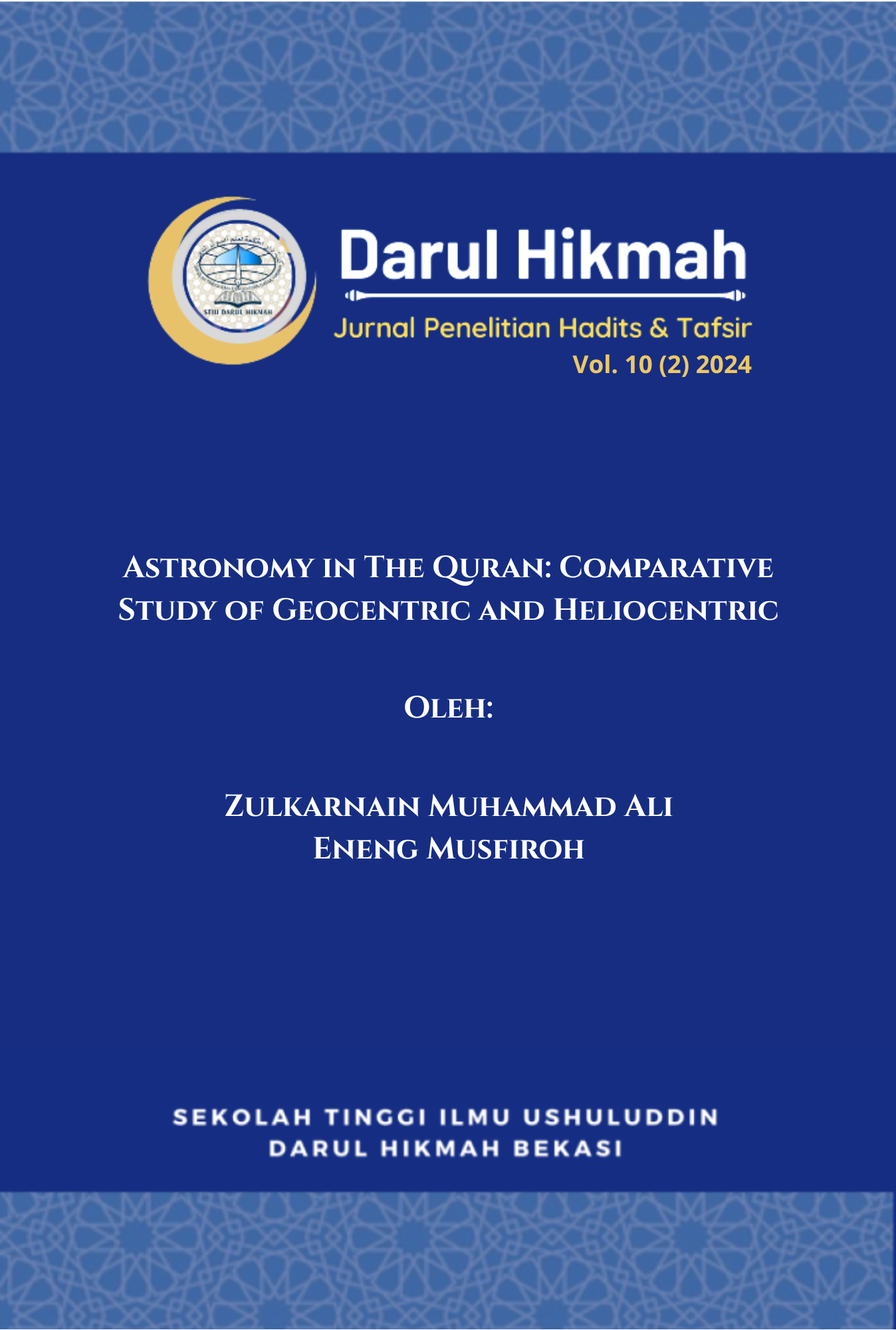
Astronomy in The Quran: Comparative Study of Geocentric and Heliocentric
DOI:
https://doi.org/10.61086/jstiudh.v10i2.74Keywords:
Astronomy, Geocentrism, Heliocentrism, Fakhruddin Al-Razi, Musthafa Al-MaraghiAbstract
The study of the Qur'an has evolved significantly from the time of the Prophet Muhammad ﷺ to the present, reflecting its timeless relevance and emphasis on knowledge, including astronomy. The Qur'an contains numerous verses referencing celestial phenomena, encouraging reflection on the cosmos as a sign of Allah’s greatness and wisdom. This research explores Islamic perspectives on geocentrism and heliocentrism by analyzing Qur'anic verses related to astronomy. It investigates whether the Qur'an implies an Earth-centered universe (geocentrism) or aligns with the heliocentric model, which places the sun at the center. The study uses philosophical, scientific (`ilmy), and literary (adabi) approaches to examine the interpretations of scholars such as Fakhruddin Al-Razi, Musthafa Al-Maraghi, and others. Findings show a diversity of scholarly opinions, shaped by the scientific knowledge available during their respective eras. Some verses appear to support a geocentric view, while others resonate with heliocentric ideas. This variation underscores how Qur'anic interpretation evolves alongside scientific advancement, reflecting the dynamic interplay between revelation and reason in Islamic thought. The study emphasizes the Qur'an’s role in encouraging inquiry and its continued relevance in bridging religious teachings with modern science. It highlights the need for ongoing scholarly engagement to deepen understanding of both the Qur'an and the natural world.
Downloads
Published
Issue
Section
License
This work is licensed under a Creative Commons Attribution-NonCommercial-ShareAlike 4.0 International License.
You are free to:
- Share — copy and redistribute the material in any medium or format
- Adapt — remix, transform, and build upon the material
- The licensor cannot revoke these freedoms as long as you follow the license terms.
Under the following terms:
- Attribution — You must give appropriate credit, provide a link to the license, and indicate if changes were made. You may do so in any reasonable manner, but not in any way that suggests the licensor endorses you or your use.
- NonCommercial — You may not use the material for commercial purposes.
- ShareAlike — If you remix, transform, or build upon the material, you must distribute your contributions under the same license as the original.
- No additional restrictions — You may not apply legal terms or technological measures that legally restrict others from doing anything the license permits.
Notices:
You do not have to comply with the license for elements of the material in the public domain or where your use is permitted by an applicable exception or limitation.
No warranties are given. The license may not give you all of the permissions necessary for your intended use. For example, other rights such as publicity, privacy, or moral rights may limit how you use the material.