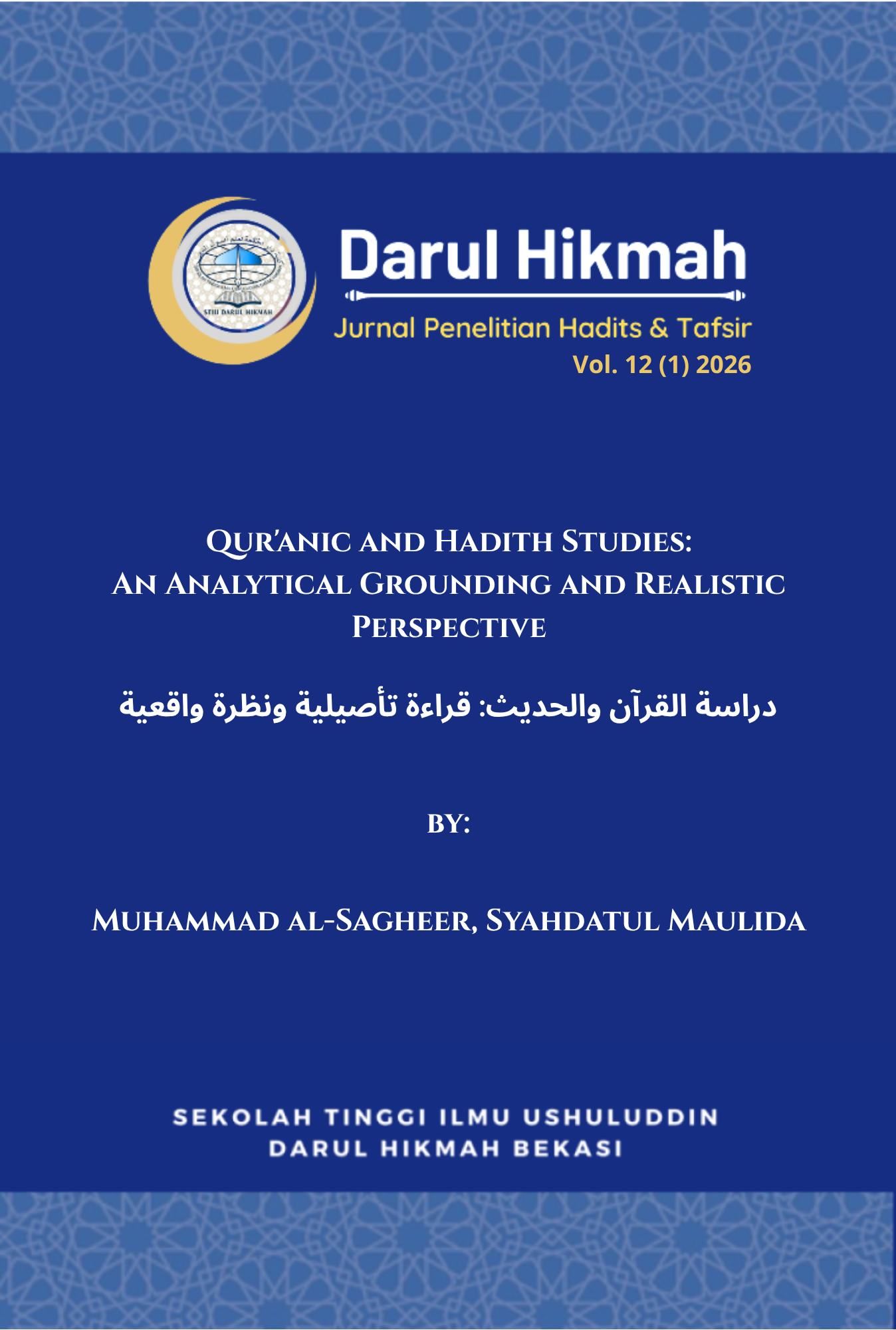
Qur'anic and Hadith Studies: An Analytical Grounding and Realistic Perspective
DOI:
https://doi.org/10.61086/jstiudh.v12i1.100Keywords:
Sharia Studies, Sanad, Islamic EducationAbstract
Contemporary Qur’anic and Hadith studies face profound epistemological, methodological, and cultural challenges driven by modern ideological shifts and the unverified influx of digital information. This study aims to elucidate these paramount hurdles and envision future prospects by nurturing a unique generation that integrates textual memorization with conceptual comprehension and the Prophetic Sunnah. Employing a descriptive-analytical method based on a critical tracing of Islamic education, this paper presents the “Markaz Al-Qubbah Al-Khadhra' li Hifzh As-Sunnah An-Nabawiyyah (The Al-Qubbah Al-Khadhra Center for Prophetic Sunnah Memorization)” established in 2025 as a case study. The analysis reveals that the methodological dichotomy between mechanical memorization and semantic comprehension breeds cognitive fragmentation, leading to dry, literalist readings and deviant interpretations. Thus, an integrative framework merging memorization, contemplation, and practice is strictly required. Second, the revival of the Sanad methodology, auditory councils, and oral transmission serves as a vital academic quality control system to safeguard sacred texts. The Al-Qubbah Al-Khadhra Center’s empirical indicators, attracting over 30,000 students from 500 cities worldwide within a single year, demonstrates that scaling Islamic knowledge internationally does not require compromising the strict standards of classical heritage (turats). The study recommends adopting this robust institutional model as a strategic framework for international educational centers, emphasizing that the future of Qur’anic and Hadith studies hinges upon adapting modern tools to preserve textual authenticity and divine guidance in a changing world.
Downloads
Published
Issue
Section
License
Copyright (c) 2026 Darul Hikmah: Jurnal Penelitian Hadits dan Tafsir

This work is licensed under a Creative Commons Attribution-NonCommercial-ShareAlike 4.0 International License.
This work is licensed under a Creative Commons Attribution-NonCommercial-ShareAlike 4.0 International License.
You are free to:
- Share — copy and redistribute the material in any medium or format
- Adapt — remix, transform, and build upon the material
- The licensor cannot revoke these freedoms as long as you follow the license terms.
Under the following terms:
- Attribution — You must give appropriate credit, provide a link to the license, and indicate if changes were made. You may do so in any reasonable manner, but not in any way that suggests the licensor endorses you or your use.
- NonCommercial — You may not use the material for commercial purposes.
- ShareAlike — If you remix, transform, or build upon the material, you must distribute your contributions under the same license as the original.
- No additional restrictions — You may not apply legal terms or technological measures that legally restrict others from doing anything the license permits.
Notices:
You do not have to comply with the license for elements of the material in the public domain or where your use is permitted by an applicable exception or limitation.
No warranties are given. The license may not give you all of the permissions necessary for your intended use. For example, other rights such as publicity, privacy, or moral rights may limit how you use the material.