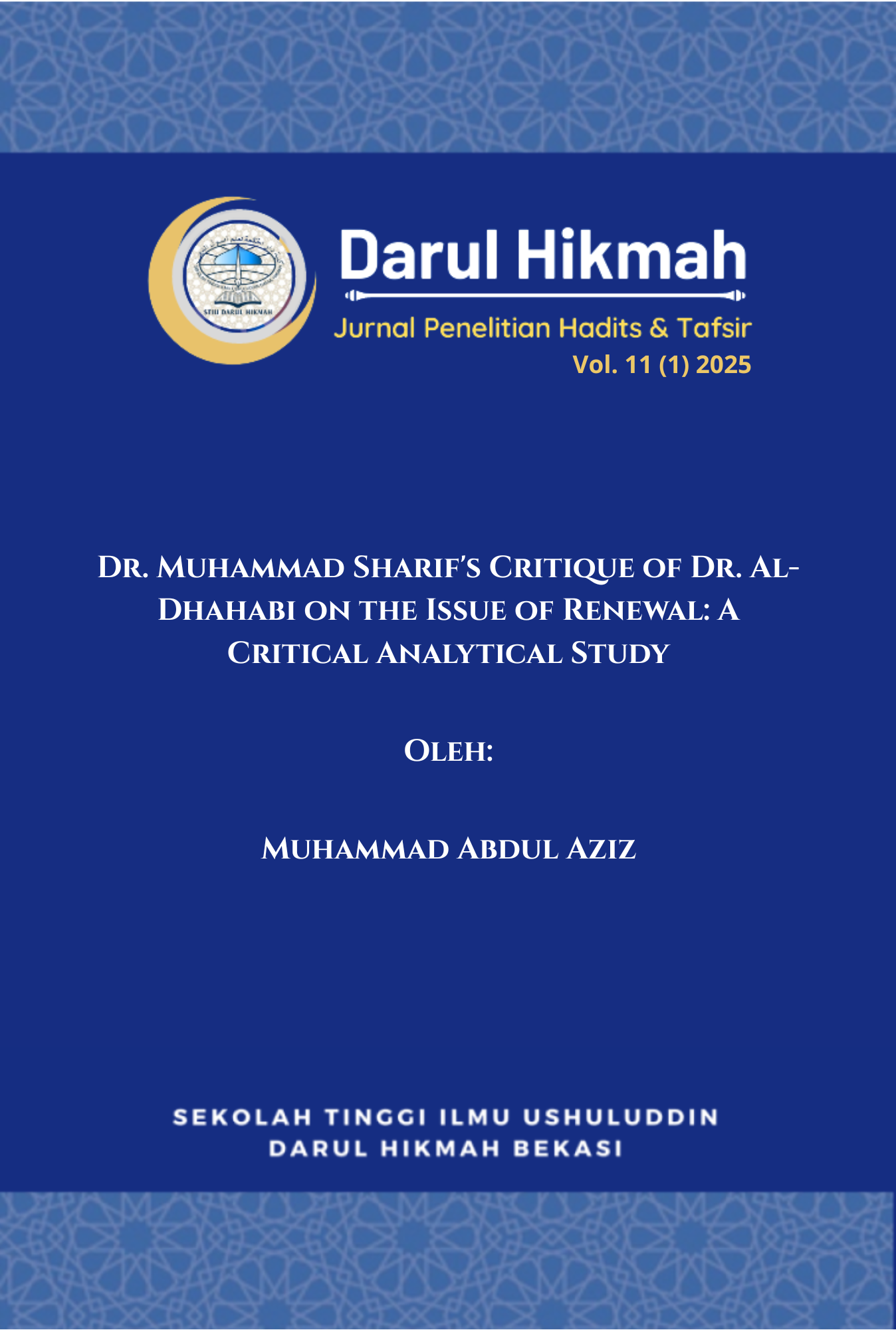
Dr. Muhammad Sharif's Critique of Dr. Al-Dhahabi on the Issue of Renewal: A Critical Analytical Study
DOI:
https://doi.org/10.61086/jstiudh.v11i1.60Kata Kunci:
Muhammad Sharif, Muhammad al-Dhahabi, tajdīd, scholarly criticism, objectivityAbstrak
This study critically examines Dr. Muhammad Sharif’s perspective on the concept of tajdīd (renewal) as articulated by Dr. Muhammad al-Dhahabi, with particular attention to his objection to al-Dhahabi’s claim that the early scholars left no room for contribution by later generations. The study also assesses the extent to which Dr. Sharif maintained scholarly objectivity and fairness in his critique, avoiding blind partisanship and methodological shortcomings that could weaken academic criticism. The research adopts a critical-evaluative approach by comparing the viewpoints of both scholars and analyzing them through an objective academic lens. The findings indicate that, in general, Dr. Sharif demonstrated a commendable adherence to the principle of fairness in his critical approach. Nonetheless, the study identified certain instances where he appeared to withhold justifiable defense from Dr. al-Dhahabi, such as in the latter’s omission of several contemporary exegetes in his scholarly treatment.
Unduhan
Diterbitkan
Terbitan
Bagian
Lisensi
This work is licensed under a Creative Commons Attribution-NonCommercial-ShareAlike 4.0 International License.
You are free to:
- Share — copy and redistribute the material in any medium or format
- Adapt — remix, transform, and build upon the material
- The licensor cannot revoke these freedoms as long as you follow the license terms.
Under the following terms:
- Attribution — You must give appropriate credit, provide a link to the license, and indicate if changes were made. You may do so in any reasonable manner, but not in any way that suggests the licensor endorses you or your use.
- NonCommercial — You may not use the material for commercial purposes.
- ShareAlike — If you remix, transform, or build upon the material, you must distribute your contributions under the same license as the original.
- No additional restrictions — You may not apply legal terms or technological measures that legally restrict others from doing anything the license permits.
Notices:
You do not have to comply with the license for elements of the material in the public domain or where your use is permitted by an applicable exception or limitation.
No warranties are given. The license may not give you all of the permissions necessary for your intended use. For example, other rights such as publicity, privacy, or moral rights may limit how you use the material.