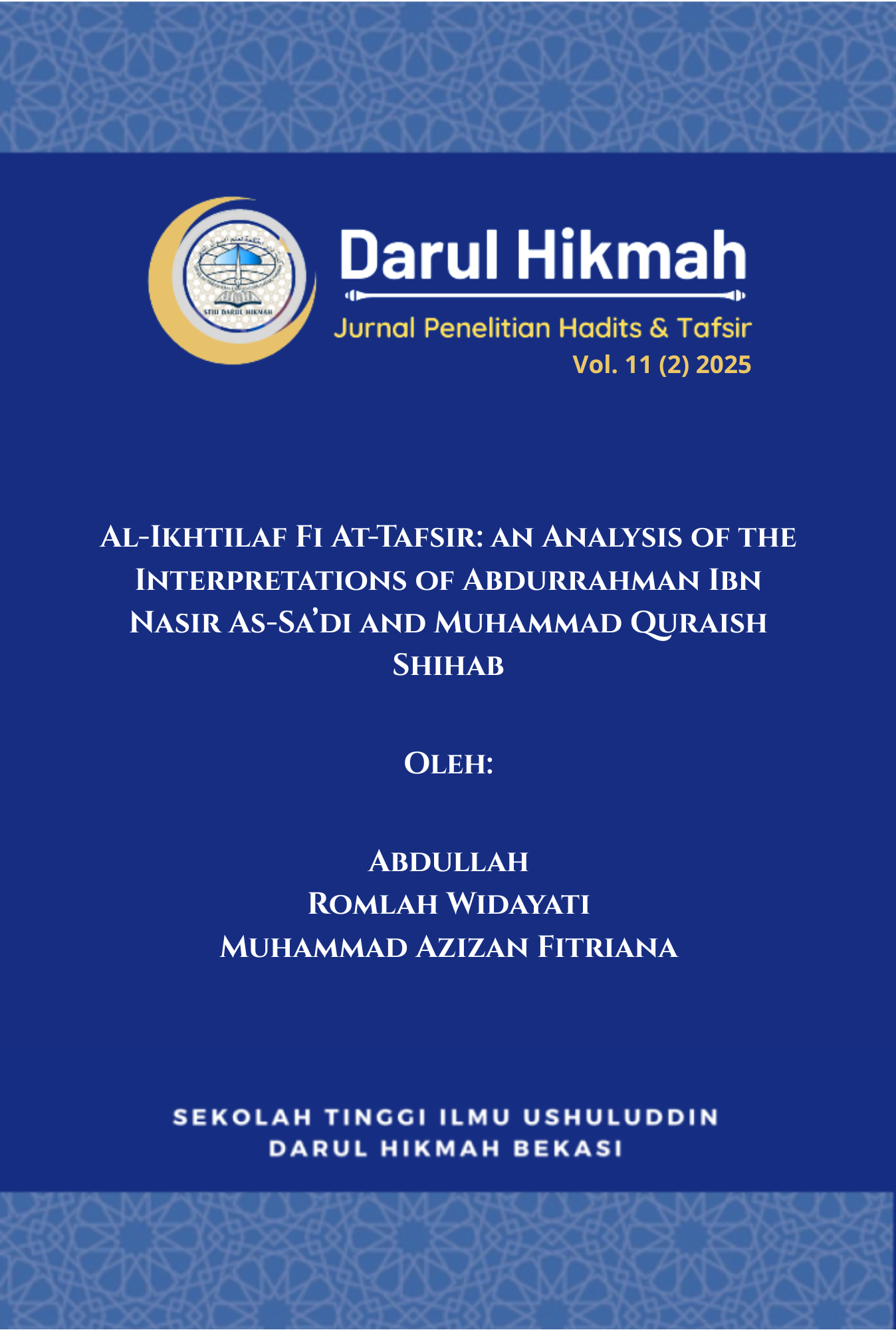
Al-Ikhtilaf Fi At-Tafsir: An Analysis of the Interpretations of Abdurrahman Ibn Nasir As-Sa’di and Muhammad Quraish Shihab
DOI:
https://doi.org/10.61086/jstiudh.v11i2.93الكلمات المفتاحية:
Al-Ikhtilaf fi at-Tafsir، As-Sa’di، Quraish Shihabالملخص
The interpretation of the Qur'an is a crucial element in understanding the meaning and message of its verses. However, in practice, differences in interpretation, or al-ikhtilaf fi at-tafsir, often occur among both early (salaf) and later (khalaf) scholars, and have existed even since the time of the Prophet Muhammad (peace be upon him). Al-ikhtilaf fi at-tafsir is divided into two main types: Disagreement that is reducible to a single meaning and Disagreement that is based on multiple meanings, each with its own forms and characteristics. This study uses a library research method and is qualitative in nature. The author found that As-Sa'di's method in interpreting verses containing al-ikhtilaf involves three approaches: not explaining the existence of a difference and choosing the opinion he deems correct; mentioning the difference without choosing one of the opinions; and explaining the difference, then selecting the opinion he deems correct. Meanwhile, Quraish Shihab uses two approaches: explaining the existence of a difference without choosing one of the opinions, and selecting the opinion he deems correct.
التنزيلات
منشور
إصدار
القسم
الرخصة
This work is licensed under a Creative Commons Attribution-NonCommercial-ShareAlike 4.0 International License.
You are free to:
- Share — copy and redistribute the material in any medium or format
- Adapt — remix, transform, and build upon the material
- The licensor cannot revoke these freedoms as long as you follow the license terms.
Under the following terms:
- Attribution — You must give appropriate credit, provide a link to the license, and indicate if changes were made. You may do so in any reasonable manner, but not in any way that suggests the licensor endorses you or your use.
- NonCommercial — You may not use the material for commercial purposes.
- ShareAlike — If you remix, transform, or build upon the material, you must distribute your contributions under the same license as the original.
- No additional restrictions — You may not apply legal terms or technological measures that legally restrict others from doing anything the license permits.
Notices:
You do not have to comply with the license for elements of the material in the public domain or where your use is permitted by an applicable exception or limitation.
No warranties are given. The license may not give you all of the permissions necessary for your intended use. For example, other rights such as publicity, privacy, or moral rights may limit how you use the material.