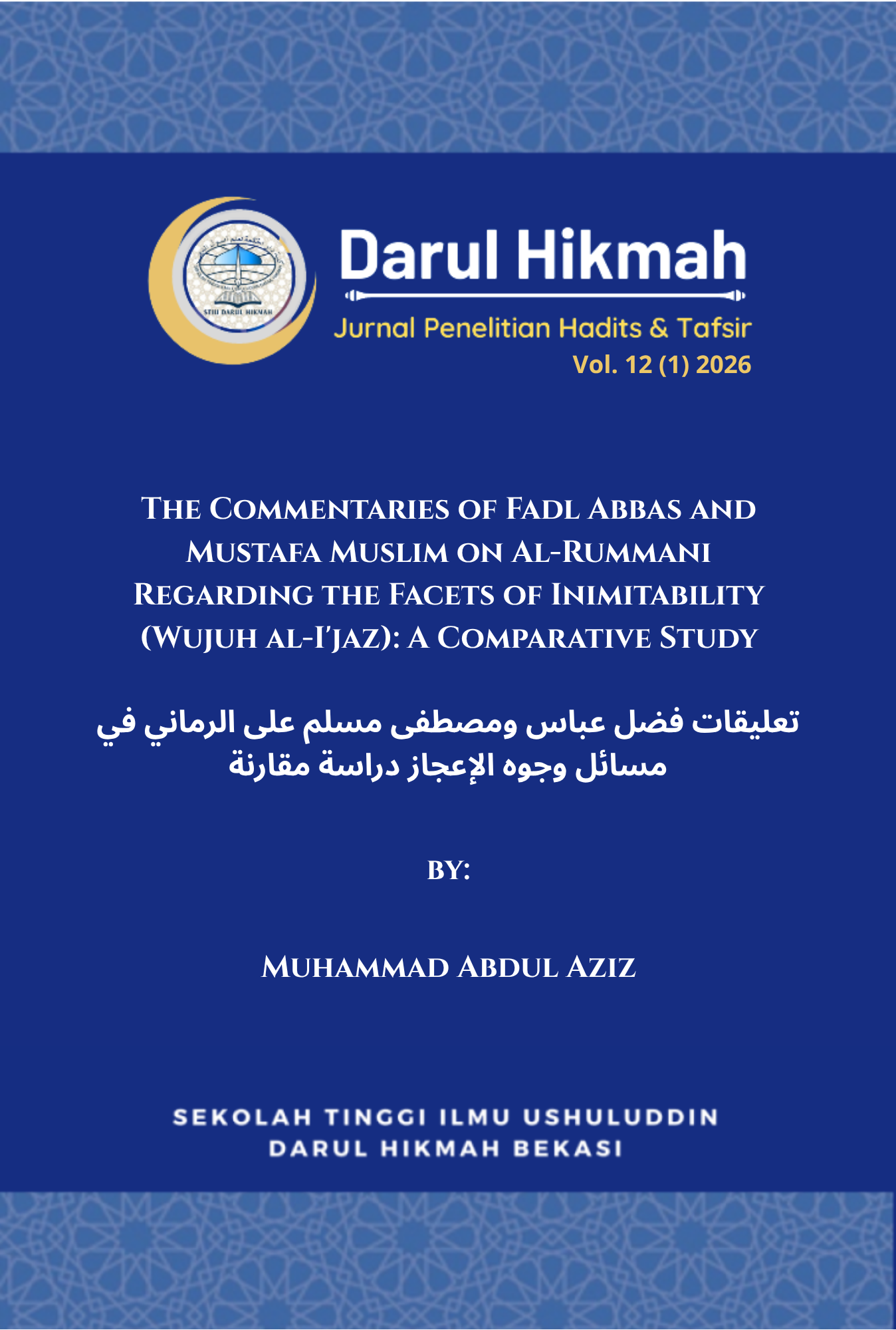
The Commentaries of Fadl Abbas and Mustafa Muslim on Al-Rummani Regarding the Facets of Inimitability (Wujuh al-I'jaz): A Comparative Study
DOI:
https://doi.org/10.61086/jstiudh.v12i1.98Keywords:
Wujuh al-I'jaz, Fadl Abbas, SarfahAbstract
This research aims to present an analytical-comparative study of the commentaries of Professor Dr. Fadl Hasan Abbas and Dr. Mustafa Muslim on the treatise “Al-Nukat fi I'jaz al-Qur'an” by the Mu'tazilite scholar Abu al-Hasan al-Rummani. The importance of this study lies in deconstructing Al-Rummani's rhetorical and theological propositions and re-evaluating them from a contemporary perspective. The research adopts an analytical-comparative methodology. The study reached several substantial results; most notably, that Dr. Fadl Abbas succeeded in resolving the alleged contradiction attributed to Al-Rummani in combining both rhetoric (balaghah) and turning-away (sarfah), demonstrating that Al-Rummani adopts the second doctrine of sarfah (the stripping away of knowledge and motivation upon attempting to counter the Qur'an), which does not contradict the notion of intrinsic, inimitable rhetoric, thereby distinguishing his view from that of Al-Nazzam. Meanwhile, the scholarly critique regarding the issue of rhymed prose (saj') focused on the necessity of making a solid distinction between artificial, blameworthy rhymed prose and the praiseworthy rhymed prose of Quranic cadences (saj' al-fawasil), which is built upon the harmony of meanings, in order to exhalt the Qur'an above any resemblance to the speech of soothsayers or the "cooing of doves" (saj' al-hamamah) as conceptualized by the Mu'tazilah.
Downloads
Published
Issue
Section
License
Copyright (c) 2026 Darul Hikmah: Jurnal Penelitian Hadits dan Tafsir

This work is licensed under a Creative Commons Attribution-NonCommercial-ShareAlike 4.0 International License.
This work is licensed under a Creative Commons Attribution-NonCommercial-ShareAlike 4.0 International License.
You are free to:
- Share — copy and redistribute the material in any medium or format
- Adapt — remix, transform, and build upon the material
- The licensor cannot revoke these freedoms as long as you follow the license terms.
Under the following terms:
- Attribution — You must give appropriate credit, provide a link to the license, and indicate if changes were made. You may do so in any reasonable manner, but not in any way that suggests the licensor endorses you or your use.
- NonCommercial — You may not use the material for commercial purposes.
- ShareAlike — If you remix, transform, or build upon the material, you must distribute your contributions under the same license as the original.
- No additional restrictions — You may not apply legal terms or technological measures that legally restrict others from doing anything the license permits.
Notices:
You do not have to comply with the license for elements of the material in the public domain or where your use is permitted by an applicable exception or limitation.
No warranties are given. The license may not give you all of the permissions necessary for your intended use. For example, other rights such as publicity, privacy, or moral rights may limit how you use the material.