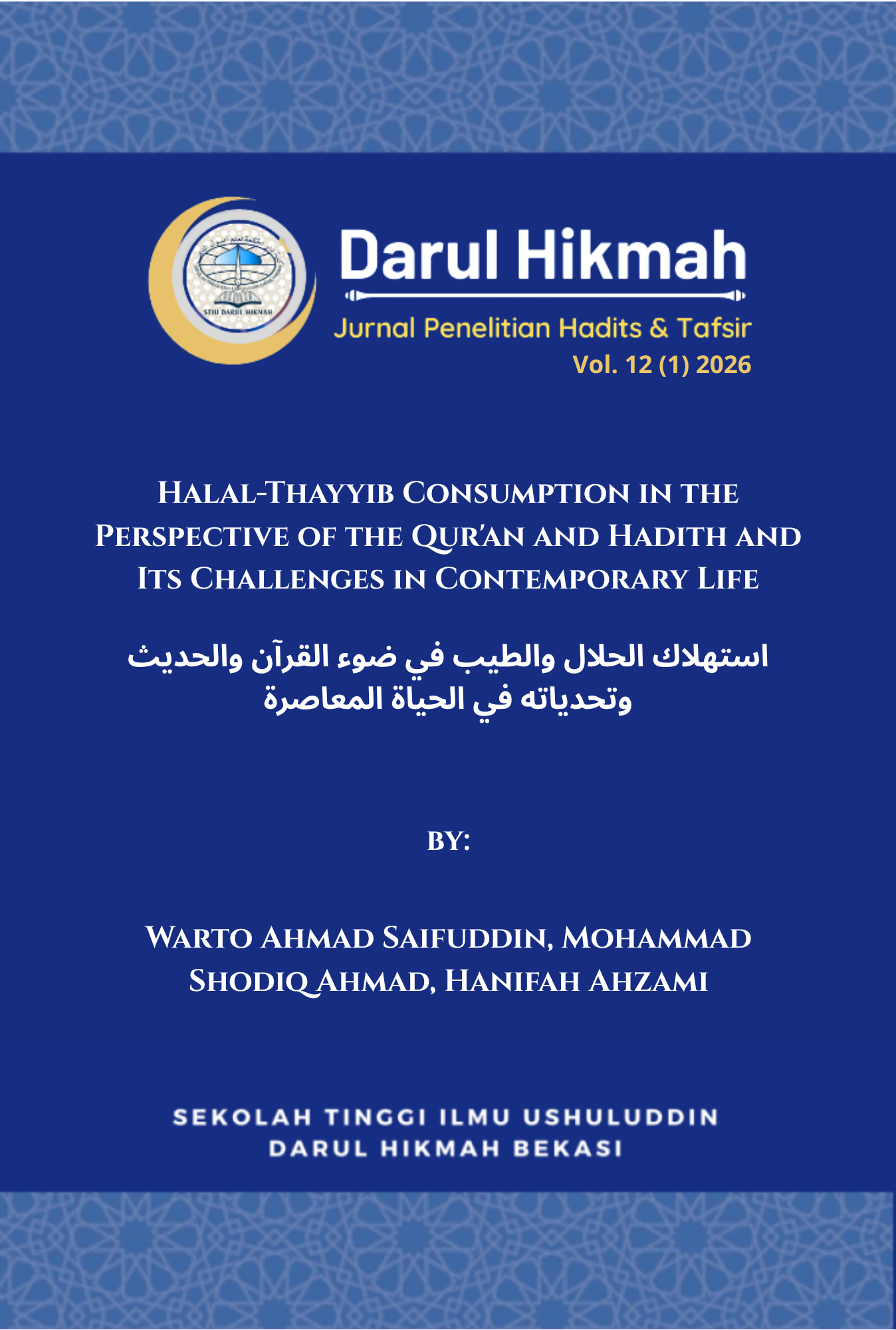
Halal-Thayyib Consumption in the Perspective of the Qur'an and Hadith and Its Challenges in Contemporary Life
DOI:
https://doi.org/10.61086/jstiudh.v12i6.97Keywords:
Halalan Thayyiban, Economic Exegesis, Cultured MeatAbstract
This article presents a comprehensive and in-depth analysis of the concept of Halalan Thayyiban in Islam, tracing its theological foundations in the Qur’an and Hadith, as well as its pressing relevance amid the complexities of contemporary life. In the era of the Fourth Industrial Revolution, the global food supply chain faces unprecedented challenges such as genetic modification (GMO), laboratory-cultivated meat (cultured meat), and logistical complexities that increase the risks of contamination and ambiguous areas (syubhat). This study employs a qualitative approach using tahlili and maudu‘i (thematic) interpretation methods, comparative analysis of contemporary Islamic jurisprudence (fiqh), and synthesis with modern quality management practices. The findings reveal that the concept of thayyib is not merely a complementary aspect of halal, but a fundamental pillar encompassing food safety, nutritional value, environmental ethics (green deen), and economic sustainability. From classical to contemporary exegesis perspectives, the meaning of thayyib has transformed from merely “pleasant” to the senses into “safe, healthy, and ethical.”The study also highlights the profound spiritual correlation between consuming unlawful or dubious food and the rejection of prayers, as well as the hardening of the heart (qasawat al-qalb), as explained by Imam al-Ghazali. As a solution to supply chain integrity challenges, this article recommends the integration of the Halal Assurance System (HAS 23000) with international quality management standards (ISO 22000), alongside the adoption of blockchain technology to ensure traceability from upstream to downstream. This ensures that Muslims consume not only products that are legally permissible (halal) but also substantially of high quality (thayyib).
Downloads
Published
Issue
Section
License
Copyright (c) 2026 Darul Hikmah: Jurnal Penelitian Hadits dan Tafsir

This work is licensed under a Creative Commons Attribution-NonCommercial-ShareAlike 4.0 International License.
This work is licensed under a Creative Commons Attribution-NonCommercial-ShareAlike 4.0 International License.
You are free to:
- Share — copy and redistribute the material in any medium or format
- Adapt — remix, transform, and build upon the material
- The licensor cannot revoke these freedoms as long as you follow the license terms.
Under the following terms:
- Attribution — You must give appropriate credit, provide a link to the license, and indicate if changes were made. You may do so in any reasonable manner, but not in any way that suggests the licensor endorses you or your use.
- NonCommercial — You may not use the material for commercial purposes.
- ShareAlike — If you remix, transform, or build upon the material, you must distribute your contributions under the same license as the original.
- No additional restrictions — You may not apply legal terms or technological measures that legally restrict others from doing anything the license permits.
Notices:
You do not have to comply with the license for elements of the material in the public domain or where your use is permitted by an applicable exception or limitation.
No warranties are given. The license may not give you all of the permissions necessary for your intended use. For example, other rights such as publicity, privacy, or moral rights may limit how you use the material.