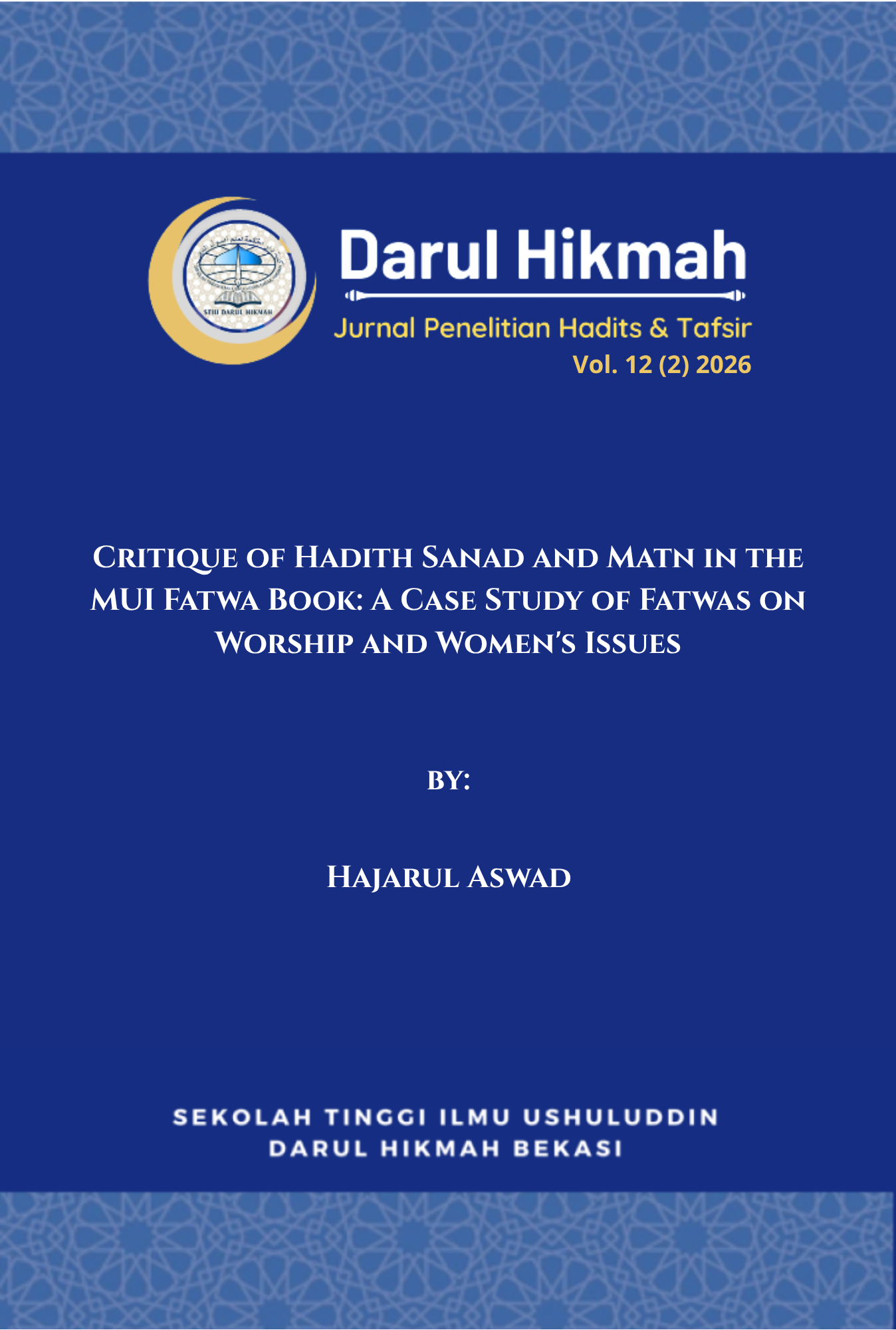
Critique of Hadith Sanad and Matn in the MUI Fatwa Book: A Case Study of Fatwas on Worship and Women's Issues
DOI:
https://doi.org/10.61086/qh0j6d85Kata Kunci:
Takhrij, Keritik, Hadis, Fatwa MUI, AnalisisAbstrak
Penelitian ini bertujuan untuk menguji validitas metodologis hadis yang digunakan oleh Majelis Ulama Indonesia (MUI) dalam menetapkan fatwa bidang ibadah, dengan fokus pada fatwa krusial seperti: Perempuan Menjadi Imam Shalat, Larangan Khitān Perempuan. Kajian ini menekankan kepada keritik sanad dan matan hadis pada fatwa MIU bidang ibadah. Penelitian ini penting sebagai barometer sumber hukum sekunder (hadis) dalam merespons dinamika hukum Islam. Dengan menggunakan metode kualitatif berbasis studi kepustakaan (library research), lalu diolah dengan menggunakan metode dekskriptif-komparatif. Penelitian ini menerapkan perangkat ilmu kritik hadis (naqd al-ḥadīṡ) yang meliputi pelacakan teks (takhrīj), penggambaran bagan sanad (i’tibār), penilaian otoritas perawi (jarḥ wa al-ta’dīl), ketersambungan generasi (ittiṣāl al-sanad), hingga analisis tekstual (naqd al-matan). Penelitian ini menyarankan pentingnya penguatan verifikasi hadis (takhrīj) yang lebih ketat dalam proses perumusan fatwa agar validitas hukum yang dihasilkan lebih kokoh secara akademik. Penulis menemukan hadis-hadis yang sanad-nya dhaif namun secara matan dapat diterima (maqbul). Karena pada matanya tersebut tidak bertentangan dengan hadis yang lebih kuat, serta tidak bertentangan dalil qat’i yakni al-Qur’an. Dan penulis menemukan beberapa riwayat hadis yang tidak diambil langsung MUI dalam kitab hadis yang muktabar, melainkan diambil dari kitab hadis fikih, pada dasarnya bukan termasuk kitab hadis.
Unduhan
Diterbitkan
Terbitan
Bagian
Lisensi
Hak Cipta (c) 2026 Darul Hikmah: Jurnal Penelitian Tafsir dan Hadits

Artikel ini berlisensiCreative Commons Attribution-NonCommercial-ShareAlike 4.0 International License.
This work is licensed under a Creative Commons Attribution-NonCommercial-ShareAlike 4.0 International License.
You are free to:
- Share — copy and redistribute the material in any medium or format
- Adapt — remix, transform, and build upon the material
- The licensor cannot revoke these freedoms as long as you follow the license terms.
Under the following terms:
- Attribution — You must give appropriate credit, provide a link to the license, and indicate if changes were made. You may do so in any reasonable manner, but not in any way that suggests the licensor endorses you or your use.
- NonCommercial — You may not use the material for commercial purposes.
- ShareAlike — If you remix, transform, or build upon the material, you must distribute your contributions under the same license as the original.
- No additional restrictions — You may not apply legal terms or technological measures that legally restrict others from doing anything the license permits.
Notices:
You do not have to comply with the license for elements of the material in the public domain or where your use is permitted by an applicable exception or limitation.
No warranties are given. The license may not give you all of the permissions necessary for your intended use. For example, other rights such as publicity, privacy, or moral rights may limit how you use the material.