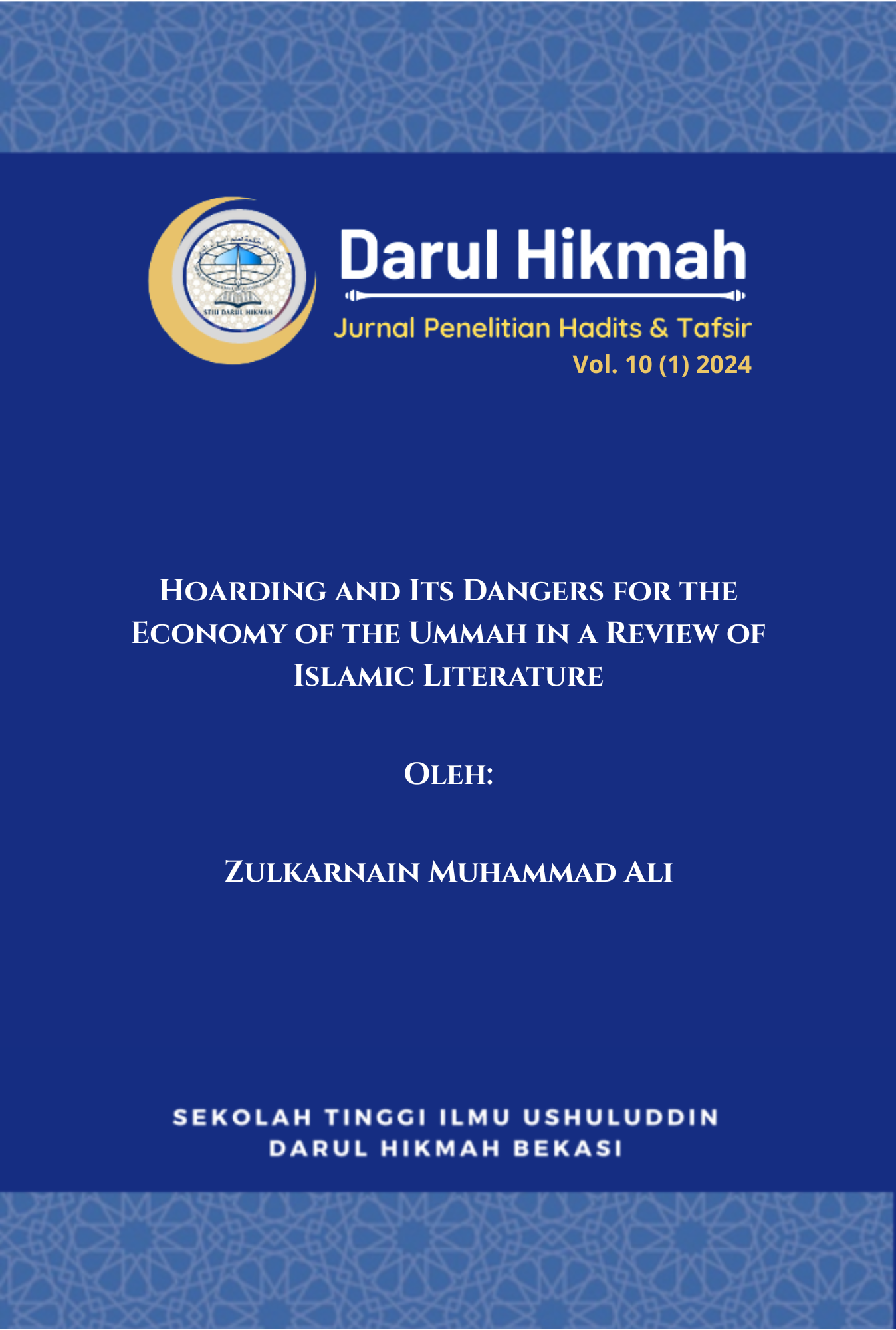
Hoarding and Its Dangers for the Economy of the Ummah in a Review of Islamic Literature
DOI:
https://doi.org/10.61086/jstiudh.v10i1.56Kata Kunci:
Penimbunan barang, Bahaya, Perekenomian Umat, Literatur IslamAbstrak
Hoarding of necessities frequently occurs in Indonesia, such as during the 2020–2022 Covid-19 pandemic, when personal protective equipment (PPE) and cooking oil became scarce. The primary cause is the behavior of some traders who hoard and monopolize goods, thus hampering distribution, leading to scarcity and unreasonable price increases. This study aims to examine the dangers of hoarding for the Muslim economy from an Islamic literary perspective and to find preventative solutions. This study used a qualitative method with a library research approach and descriptive analysis. The results show that the practice of hoarding has been known since the time of the Prophet Muhammad. In Islam, hoarding of goods is forbidden because it can reduce the availability of goods and increase prices unfairly. Classical and contemporary scholars agree that hoarding wealth or goods that harm others is reprehensible. However, Islam permits someone to keep wealth or goods for personal and family needs as long as it does not harm others. Ihtikar or hoarding is a form of unethical trade based on greed and solely oriented towards profit. The Quran and Sunnah emphasize that those who engage in ihtikar are committing a grave sin and will be punished in the afterlife. Therefore, the government plays a crucial role in preventing the practice of ihtikar through market supervision and optimizing the function of the Hisbah institution, which plays a vital role in maintaining economic, social, and moral justice in society.
Unduhan
Diterbitkan
Terbitan
Bagian
Lisensi
This work is licensed under a Creative Commons Attribution-NonCommercial-ShareAlike 4.0 International License.
You are free to:
- Share — copy and redistribute the material in any medium or format
- Adapt — remix, transform, and build upon the material
- The licensor cannot revoke these freedoms as long as you follow the license terms.
Under the following terms:
- Attribution — You must give appropriate credit, provide a link to the license, and indicate if changes were made. You may do so in any reasonable manner, but not in any way that suggests the licensor endorses you or your use.
- NonCommercial — You may not use the material for commercial purposes.
- ShareAlike — If you remix, transform, or build upon the material, you must distribute your contributions under the same license as the original.
- No additional restrictions — You may not apply legal terms or technological measures that legally restrict others from doing anything the license permits.
Notices:
You do not have to comply with the license for elements of the material in the public domain or where your use is permitted by an applicable exception or limitation.
No warranties are given. The license may not give you all of the permissions necessary for your intended use. For example, other rights such as publicity, privacy, or moral rights may limit how you use the material.