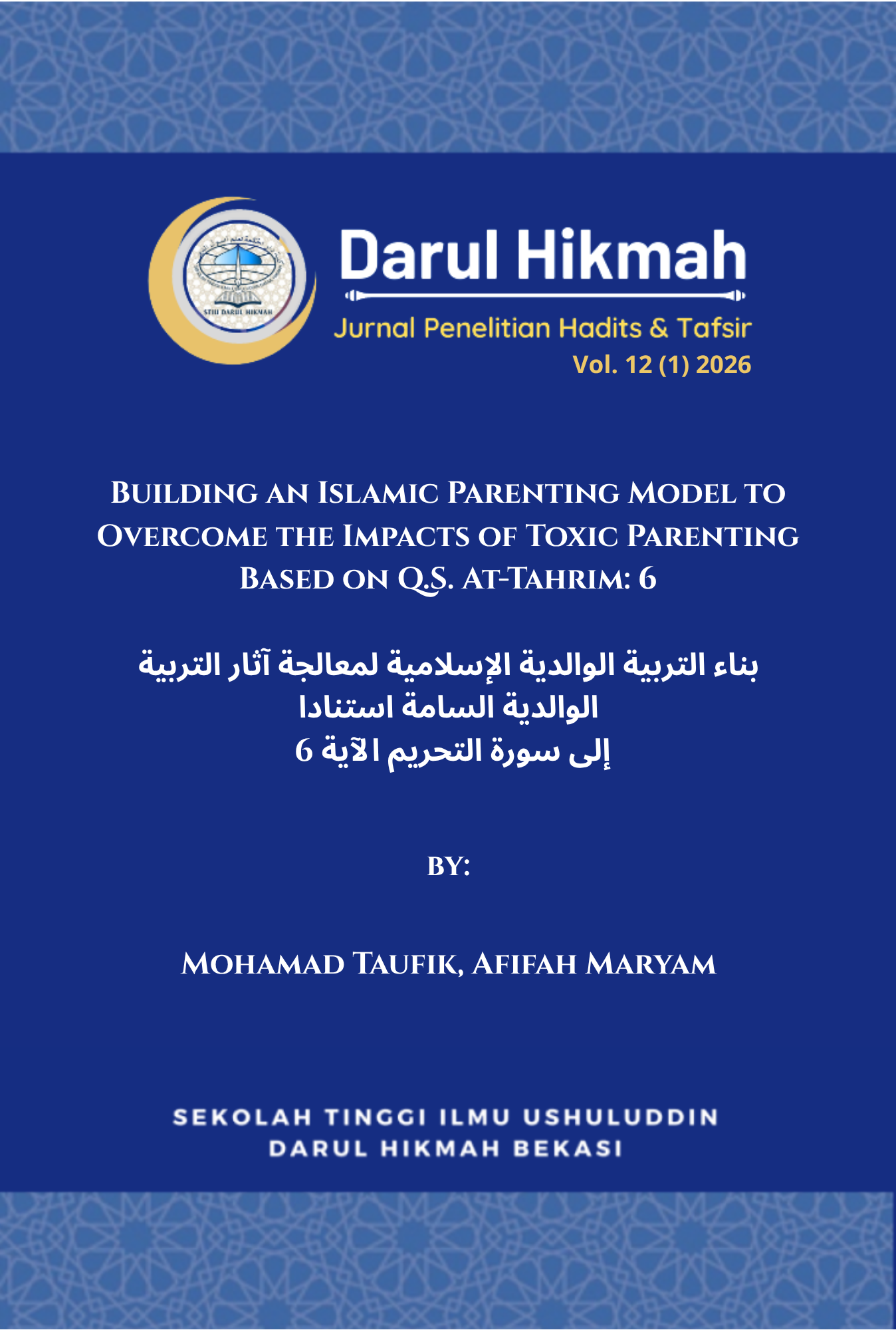
Building an Islamic Parenting Model to Overcome the Impacts of Toxic Parenting Based on Q.S. At-Tahrim: 6
DOI:
https://doi.org/10.61086/jstiudh.v12i6.96Keywords:
Toxic Parenting, Mental Health, CommunicationAbstract
This study aims to examine the perspective of Islamic parenting based on Q.S. At-Tahrim verse 6 as a theological-psychological solution to mitigate the impacts of toxic parenting on children. The method used is descriptive-analytical qualitative with a literature review (library research) approach. The applied exegesis method is the thematic (maudhu'i) method to gather verses, narratives, and mufasir interpretations, which are then synchronized with modern psychological theories regarding toxic parenting through content analysis. The results indicate that Q.S. At-Tahrim verse 6 does not only contain normative commands, but fundamentally prohibits all forms of destructive parenting (Al-Wālidu As-Sāmm) that damage the child's fitrah. The failure to maintain a child's mental health is categorized as a form of betraying Allah's trust. The novelty of this research lies in the reconstruction of the inner meaning of classical exegesis verses, contextualized into the form of deconstructing intergenerational parenting trauma. The implications of this study demand a paradigm shift in parenting from an authoritarian control model to an emotional communication model based on tarqiq (gentleness), such as the exemplar of Luqman al-Hakim. This research provides a curative roadmap for parents to undergo personal psychological behavioral rehabilitation before implementing formal sharia teachings to the child.
Downloads
Published
Issue
Section
License
Copyright (c) 2026 Darul Hikmah: Jurnal Penelitian Hadits dan Tafsir

This work is licensed under a Creative Commons Attribution-NonCommercial-ShareAlike 4.0 International License.
This work is licensed under a Creative Commons Attribution-NonCommercial-ShareAlike 4.0 International License.
You are free to:
- Share — copy and redistribute the material in any medium or format
- Adapt — remix, transform, and build upon the material
- The licensor cannot revoke these freedoms as long as you follow the license terms.
Under the following terms:
- Attribution — You must give appropriate credit, provide a link to the license, and indicate if changes were made. You may do so in any reasonable manner, but not in any way that suggests the licensor endorses you or your use.
- NonCommercial — You may not use the material for commercial purposes.
- ShareAlike — If you remix, transform, or build upon the material, you must distribute your contributions under the same license as the original.
- No additional restrictions — You may not apply legal terms or technological measures that legally restrict others from doing anything the license permits.
Notices:
You do not have to comply with the license for elements of the material in the public domain or where your use is permitted by an applicable exception or limitation.
No warranties are given. The license may not give you all of the permissions necessary for your intended use. For example, other rights such as publicity, privacy, or moral rights may limit how you use the material.