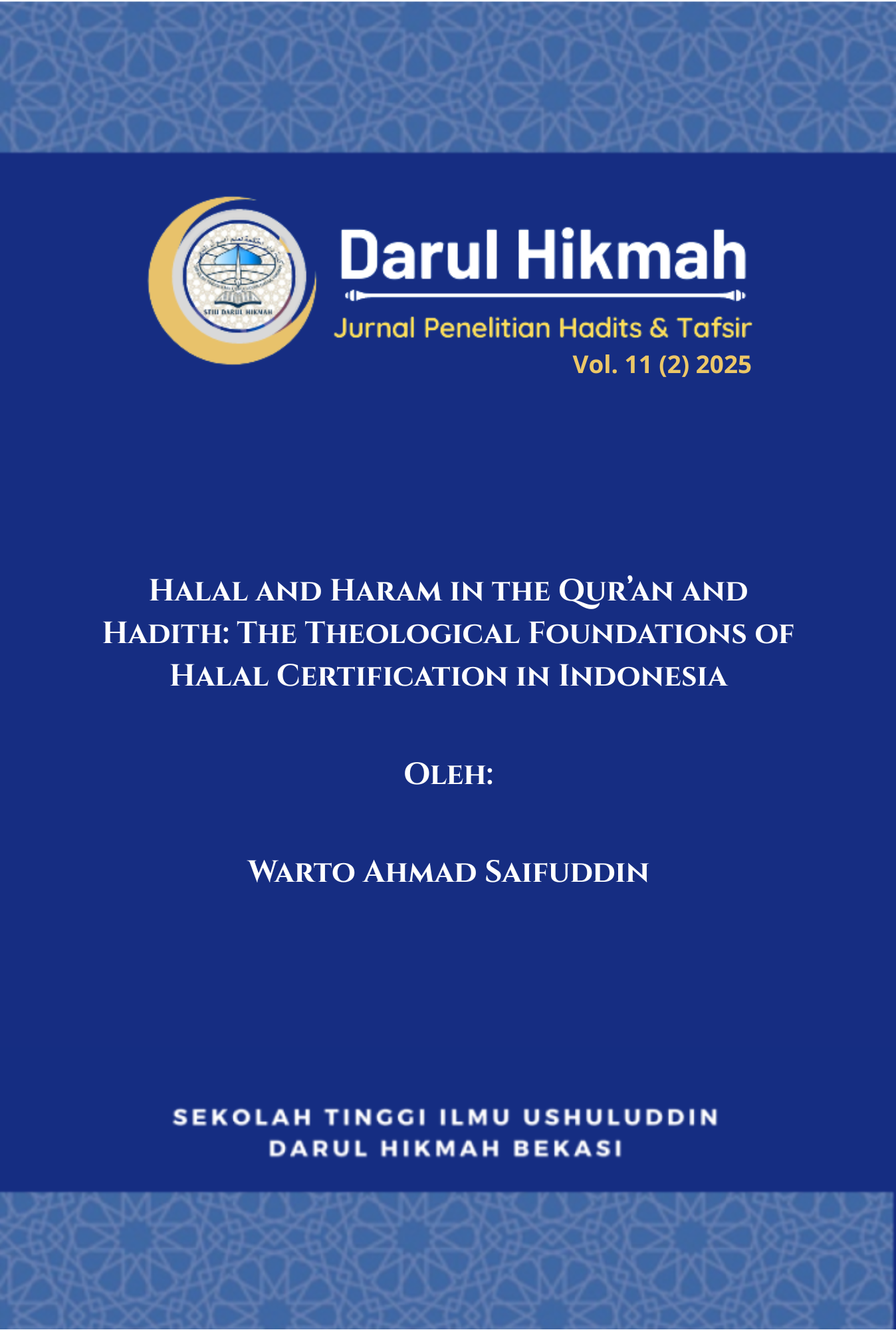
Halal and Haram in the Qur’an and Hadith: The Theological Foundations of Halal Certification in Indonesia
DOI:
https://doi.org/10.61086/jstiudh.v11i2.88Keywords:
halalan tayyiban, halal certification, Halal Management System, BPJPH, maqasid al-shari‘ahAbstract
This article examines the theological construction of halal and haram in the Qur’an and Hadith as the normative, epistemic, and operational foundation of the halal certification system in Indonesia. The study employs a qualitative approach with a thematic exegesis (maudhu‘i) design applied to primary texts, combined with content analysis of regulations and standards. Primary data include Qur’anic verses on halalan tayyiban, typologies of prohibition, and hadiths concerning shubhat as well as legal maxims (qawa‘id fiqhiyyah), while secondary data consist of Law No. 33/2014, SNI 99001:2022, HAS 23000, and reputable scholarly literature. The analysis identifies four operational theological pillars: the cumulative principle of halalan tayyiban; typologies of prohibition based on substance (li ‘aynihi), process (li ghairihi), and harm; legal maxims as risk management principles (al-yaqin la yazulu bi al-shakk, la darar wa la dirar, sadd al-dhara’i); and maqasid al-shari‘ah as governance objectives. These pillars are directly aligned with the clauses of the Halal Management System SNI 99001:2022 and the BPJPH–LPH–MUI mechanism. The findings present a replicable framework of revelation–fiqh–standards integration, propose a Halal Critical Control Points (HCCP) model compatible with HACCP, and emphasize the role of digital traceability in upholding the principle of certainty (al-yaqin). The practical implications include strengthening the integrity of the halal supply chain, enhancing the accountability of fatwa decisions, and improving the competitiveness of the national halal industry.
Downloads
Published
Issue
Section
License
This work is licensed under a Creative Commons Attribution-NonCommercial-ShareAlike 4.0 International License.
You are free to:
- Share — copy and redistribute the material in any medium or format
- Adapt — remix, transform, and build upon the material
- The licensor cannot revoke these freedoms as long as you follow the license terms.
Under the following terms:
- Attribution — You must give appropriate credit, provide a link to the license, and indicate if changes were made. You may do so in any reasonable manner, but not in any way that suggests the licensor endorses you or your use.
- NonCommercial — You may not use the material for commercial purposes.
- ShareAlike — If you remix, transform, or build upon the material, you must distribute your contributions under the same license as the original.
- No additional restrictions — You may not apply legal terms or technological measures that legally restrict others from doing anything the license permits.
Notices:
You do not have to comply with the license for elements of the material in the public domain or where your use is permitted by an applicable exception or limitation.
No warranties are given. The license may not give you all of the permissions necessary for your intended use. For example, other rights such as publicity, privacy, or moral rights may limit how you use the material.